
Press Release
Manifesto on the Geographical Indications of Distilled Spirits and Typical and Traditional Latin American Spirits - Sources of Culture and Economic and Social Development
The distilled beverages in Latin America, distinguished and preserved by Geographical Indications, embody our nations’ cultural legacy. Their exceptional quality, reputation and historical importance are inherently tied to their geographical roots. They are unique distilled beverages, directly linked to local traditions, and of immeasurable national value. They serve as cultural ambassadors, projecting our national identity globally while also fostering economic growth.
Geographical Indications enhance the value of agricultural property and benefit small producers. They safeguard cultural identities and traditions, as new generations understand the sustainability of the business and settle in the region to give continuity to the legacy. Increasingly, the industry is adopting and promoting environmentally and socially responsible practices.
Distillates with Geographical Indications also contribute to local value chains through bars, restaurants, hotels and other tourist services. Their protection has a direct and positive impact on the generation of jobs and income, strengthening the development of our countries and the regional economy.
Because they are so intrinsically linked to tradition, standards, their raw material, and their geographic origin, their production processes and alcohol content are factors that contribute to their distinction and recognition.
Geographical Indications enhance the value of agricultural property and benefit small producers. They safeguard cultural identities and traditions, as new generations understand the sustainability of the business and settle in the region to give continuity to the legacy. Increasingly, the industry is adopting and promoting environmentally and socially responsible practices.
Distillates with Geographical Indications also contribute to local value chains through bars, restaurants, hotels and other tourist services. Their protection has a direct and positive impact on the generation of jobs and income, strengthening the development of our countries and the regional economy.
Because they are so intrinsically linked to tradition, standards, their raw material, and their geographic origin, their production processes and alcohol content are factors that contribute to their distinction and recognition.
Modifying the characteristics of distilled beverages with initiatives such as reducing alcohol content would blur their essence and make them lose local and global competitiveness.
The characteristics of distilled beverages such as Cachaça, Tequila, Pisco and Rum, among others, are protected by national laws and international treaties. Preserving them is essential to their value chains.
Reducing harmful alcohol consumption is a priority for our industry. The protection of Geographical Indications is not only compatible with this effort but indeed contributes to it by increasing quality control. It is essential to be aware that what really matters is not the type of alcoholic beverage, but the amount of alcohol consumed. When properly served, all beverages have approximately the same absolute amount of alcohol. Thus, any moderation policy should consider the principle of equivalence (standard drink) as a central principle for consumption and when disseminating of information. After all, alcohol is alcohol.
The Geographical Indications distilled spirits industry has come together to present this manifesto to underscore the importance of these products for the countries of the region. There is a robust regulatory framework that has allowed the development and strengthening of Geographical Indications, resulting in benefits for producers and consumers.
The characteristics of distilled beverages such as Cachaça, Tequila, Pisco and Rum, among others, are protected by national laws and international treaties. Preserving them is essential to their value chains.
Reducing harmful alcohol consumption is a priority for our industry. The protection of Geographical Indications is not only compatible with this effort but indeed contributes to it by increasing quality control. It is essential to be aware that what really matters is not the type of alcoholic beverage, but the amount of alcohol consumed. When properly served, all beverages have approximately the same absolute amount of alcohol. Thus, any moderation policy should consider the principle of equivalence (standard drink) as a central principle for consumption and when disseminating of information. After all, alcohol is alcohol.
The Geographical Indications distilled spirits industry has come together to present this manifesto to underscore the importance of these products for the countries of the region. There is a robust regulatory framework that has allowed the development and strengthening of Geographical Indications, resulting in benefits for producers and consumers.
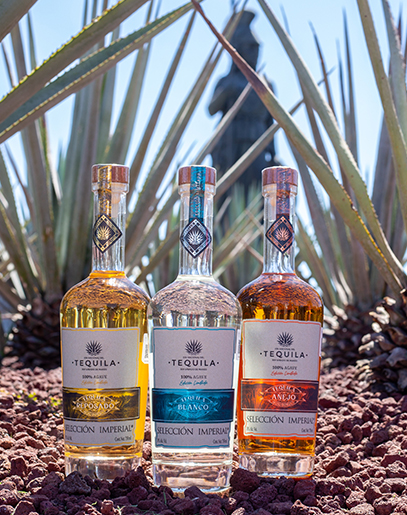
We therefore support the continuity of consistent, balanced and egalitarian regulations that continue to protect our emblematic products and encourage the development of value chains. This will benefit our societies and Latin America as a whole.
ABELAC - Latin American and Caribbean Spirits Alliance

IBRAC - Brazilian Cachaça Institute

CNIT - National Chamber of the Tequila Industry
A geographical indication (GI) is a sign used on products that have a specific geographical origin and possess qualities or a reputation that are due to that origin. In order to function as a GI, a sign must identify a product as originating in a given place.
Source: The global forum for intellectual property services, policy, information, and cooperation - WIPO
What is Geographical Indication?
Understanding the Geographical Indication and its importance
Traditional distilled spirits recognized with geographical indications are produced under a vast legal framework that standardizes and controls their characteristics. Their identities and quality standards are even part of complex international negotiations undertaken in the interests of entire nations.
The cultural, economic, and social impact of these beverages, which are responsible for an immense value chain, should not be underestimated. They add value to rural properties and stimulate small producers. They protect cultural
The cultural, economic, and social impact of these beverages, which are responsible for an immense value chain, should not be underestimated. They add value to rural properties and stimulate small producers. They protect cultural
identities and traditions, with new generations recognizing the sustainability of the business and settling in the region, continuing the legacy. They also have an impact on bars, restaurants, events, and hotels, generating employment and income.
As can be seen, products recognized and protected with geographical indications are rooted in elements far beyond the production and sale of the final product. They represent local cultures, project diplomacy, and leverage economies both regionally and globally.
As can be seen, products recognized and protected with geographical indications are rooted in elements far beyond the production and sale of the final product. They represent local cultures, project diplomacy, and leverage economies both regionally and globally.
Some myths regarding alcoholic beverages are rooted in popular culture and betray an improper understanding and practice of moderation.
The power of moderation
Explanation of concepts, more consumer protection
For many people, moderation is a subjective concept, but as the foundation for responsible consumption of alcoholic beverages, it must be explained and included as an essential part of any policy used to combat harmful alcohol consumption.Thus, from the perspective of consumer protection, it is paramount that the education and prevention campaigns historically promoted by companies and agencies associated with the spirits sector include references to help people understand how much alcoholic they are drinking and when it is time to stop.
Firstly, it is important to be clear that the only type of alcohol suitable for human consumption is ethyl alcohol (ethanol), which is found in all alcoholic beverages, without distinction, as a result of the production process. So whatever the category of drink or its alcohol content, the ethanol is always the same.
Given that it is the same active ingredient, it is logical that it is processed in the same way in the human body, regardless of whether it is from a fermented or distilled beverage. As such, the initial premise of the debate on moderation is crystal clear: alcohol is alcohol.
Standard drink: what is it and how to use it?
The standard drink is the main parameter that can be used to explain the concept of moderation, because it helps the consumer measure and control their ethanol intake, demonstrating the absolute amount of ethyl alcohol (ethanol) they are ingesting. It is also useful for comparative studies and in public policies on combating harmful consumption.
Fundación de Investigaciones Sociales A.C. - FISAC - indicates that the standard drink is a unit of measurement equivalent to a specific and established amount of pure alcohol (ethanol) per drink. This measurement varies from country to country depending on the culture, the characteristics of the population, and the geography, among other measures dictated by the local authorities.
In Mexico, for example, the official standards NOM-047-SSA2-2015 and NOM-142-SSA1/SCFI-2014 establish the value of a standard drink as 13g.
According to FISAC, the liver is primarily responsible for the metabolic processing of approximately 90% of the ethanol consumed by an individual. The body of a healthy adult male is able to metabolize a standard drink in approximately one hour, while a healthy adult female can do so in approximately one and a half hours. If intake is higher than metabolization rate, the concentration of alcohol in the blood rises, which can harm a person’s health. For this reason, the recommendation is to drink slowly and moderately, based on the standard dosage.
In short, what really matters is the absolute amount of alcohol ingested and not the type of drink or its alcohol content, since all alcohol is alcohol.
“The intensity of the effect of alcohol on the body is directly related, to the amount consumed. There is no moderate drinking, only the practice of moderation.”
US Centers for Disease Control and Prevention (CDC)
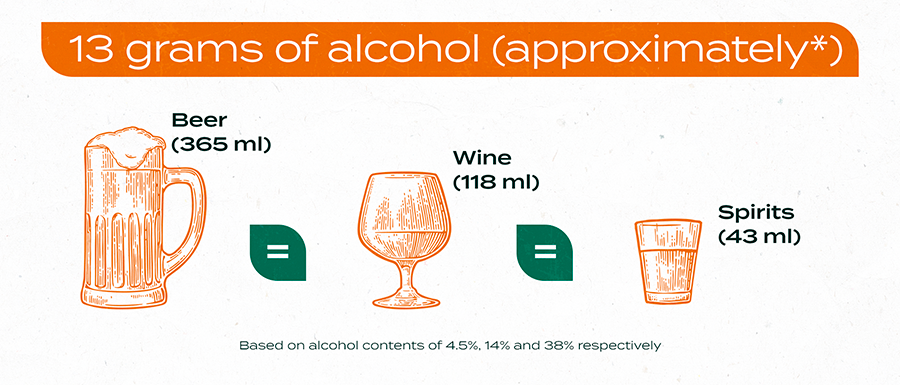
Explaining the standard drink gives an understanding of the principle of equivalence between alcoholic beverages. In Brazil, considering 14g of alcohol as a basis, whether drinking 350 ml of beer (5% alcohol content), 150 ml of wine (12%), or 40 ml of distillate beverage (40 %), the absolute amount of alcohol ingested is approximately equal at 14g.
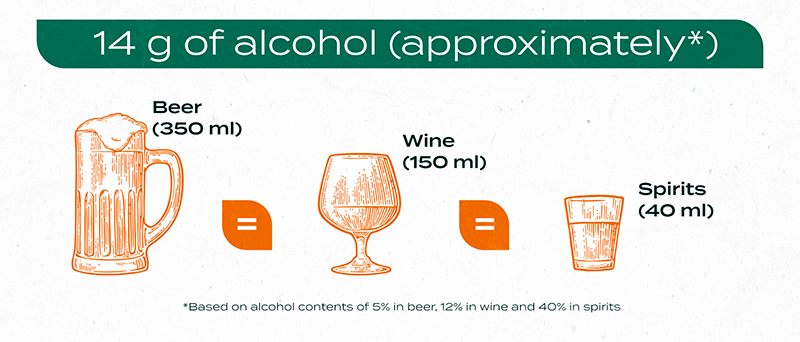
In Mexico, considering 13g of alcohol as the standard drink, the principle of equivalence between alcoholic beverages is this: with the consumption of 365 ml of a beer (with 4.5% of alcohol content), 118 ml of wine (14%) or 43 ml of distillate beverage (38 %), the absolute amount of alcohol ingested is of approximately 13g.
“If served properly and in its respective container, any alcoholic beverage contains approximately the same amount of pure alcohol.”
Fundación de Investigaciones Sociales A.C. (FISAC)
The World Health Organization (WHO) has already recommended that a healthy adult who consumes alcoholic beverages should do so according to the standard drink of 10 grams of alcohol and up to three doses for men and two doses for women per day, with at least two days in between when alcohol is not consumed.
Moderation myths
Some myths regarding alcoholic beverages are rooted in popular culture and betray an improper understanding and practice of moderation.
Segregating alcoholic beverages into strong or weak categories are examples of assumptions void of technical basis that perpetuate these myths, influencing individual choices of healthy adults who choose to drink.
Based on this type of misconception, these myths can have unintended consequences for consumers if they decide to drink a greater number of low-alcohol-content beverages thinking they are consuming less alcohol.
It is important to demystify the relationship between consumers and alcoholic beverages to enable effective moderation and the creation of public policies capable of reducing harmful consumption.
Public Debate
In 2022, the WHO suggested that whenever feasible, economic operators should replace high-alcohol beverages with non-alcoholic or low-alcohol beverages throughout their entire product portfolio, with the intent of reducing harmful consumption.
This guideline has important repercussions from the perspective of consumer protection, since simply reducing the alcohol content of beverages in order to reduce harmful consumption overlooks the fact that moderate consumption is fundamentally established by the absolute amount of alcohol consumed and not the type of drink.
Based on the standard drink and the principle of equivalence, consumers should have a deeper understanding of moderation, allowing them to make better decisions when enjoying their favorite beverage, knowing that alcohol is alcohol.
The Original Spirits movement stands behind the belief that education gives rise to responsible and moderate consumption of alcoholic beverages, regardless of alcohol content or beverage category, helping produce effective results in the fight against harmful consumption.
Video
Jessica Paredes - Standard Dose
Press
Manifesto of the distilled beverage industry with Geographical Indications in Latin America - sources of culture and economic and social development
Read more
Distilled beverages recognized and protected with Geographical Indications in Latin America are the heritage of countries
ABELAC supports fiscal and regulatory equality, based on the scientific evidence that "all drinks are equal"
Read more
A central commitment of ABELAC is to support consumer education through evidence-based research to reduce the harmful use of alcohol.…
Dimension Turistica Magazine
Read more
Tequila Industry joins the World Alcohol Action Plan promoted by the World Health Organization
La Crónica de Hoy Jalisco
Read more
CNIT in favor of lowering harmful consumption, not alcoholic graduation of tequila
Bahia Notícias
Read more
Cachaça and tequila manufacturers make manifest in defense of alcohol content
Yahoo Finanças
Read more
Cachaça and tequila manufacturers make a manifesto in defense of the alcohol content of drinks
Jornal do Comércio
Read more
Cachaça and tequila manufacturers make a manifesto in defense of the alcohol content of drinks
Turismo em Foco
Read more
Brazil and Mexico come together to bring the topic of cultural heritage to the WHO on the content of traditional…
Tribuna do Sertão
Read more
Brazil and Mexico unite in defense of typical traditional drinks with Geographical Indication
O Estado CE
Read more
Cachaça and tequila manufacturers make a manifesto in defense of the alcohol content of drinks
Folha de S.Paulo
Read more
Cachaça and tequila manufacturers make a manifesto in defense of the alcohol content of drinks